This Dragon Is Not Authorised
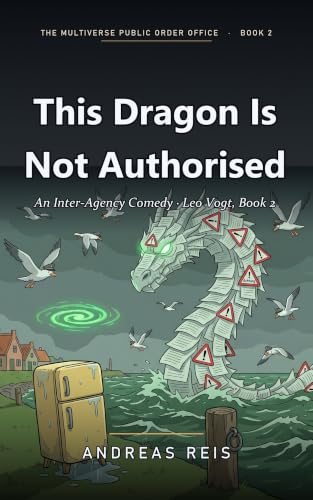
An Inter-Agency Comedy (The Multiverse Public Order Office
English Band 2 der Reihe »Leo Vogt« von Andreas Reis.
Worum es geht
Causality Oversight in Göppingen has only just learned how to administer reality — when a green letter lands in the yard. A request for administrative assistance. From elsewhere. Signed with the drawing of a dragon.
Leo Vogt had rather hoped never to see the inside of a black hole again. But the letter can't be adjourned: somewhere on the North Sea coast a foreign reality is tearing open, an overwhelmed authority is asking for help, and the sky above a small tidal-sluice village glows a green that, by Göppingen's rules, simply shouldn't exist.
So Leo, his chaos-gifted aunt Elara, the taciturn official Eberle, the bookseller Miriam — and a toaster on little legs — pack half the Public Order Office into a van that is far too small and set off. Only it turns out that their devices, their forms and their hard-won rules work half as well outside their own town. And that the people on the coast have an entirely different idea of how to process an apocalypse by the book.
The second case of The Multiverse Public Order Office: a warm, gloriously odd sci-fi comedy about tidal bureaucracy, two utterly different administrative cultures, a dragon with a request for administrative assistance — and the hardest official act of all: letting go of something you love.
Auf einen Blick
- Reihe
- The Multiverse Public Order Office, Band 2
- Umfang
- 493 Seiten (Taschenbuch)
- Ausgaben
- Kindle, Paperback
- Sprache
- English
- Autor
- Andreas Reis
- Leseprobe
- Kapitel 1 vollständig, kostenlos
Hörprobe: Kapitel 1 zum Anhören
Das komplette erste Kapitel, ungekürzt vorgelesen (18:55 Minuten). Die Aufnahme nutzt eine synthetische Stimme.
Leseprobe: Kapitel 1
Das erste Kapitel in voller Länge (2811 Wörter) - kostenlos lesen, ohne Anmeldung.
%% PART: Part One — Leaving Your Own System # Adjourned Until Tomorrow
The first morning on which the multiverse had not filed a complaint began with the fridge filing one.
“I wish to state for the record,” it rumbled from the corner of the workshop, “that the milk has gone off and nobody asked me how I feel about that.”
Leo Vogt, who had been sitting at the workbench for twenty minutes trying to begin a day without it feeling like the beginning of something larger, did not look up.
“Consulting hours are at five o’clock.”
“This is a status update, not a complaint.”
“It began with ‘I wish to state for the record.’”
“That is administrative language. Administrative language is neutral.”
“Administrative language,” said Leo, “is the least neutral language ever invented. It only sounds as though it has no feelings, so that you’ll believe it.”
The fridge thought about this, which you could tell because its compressor dropped a tone lower.
“I shall note that as a compliment.”
“You do that.”
It was, Leo registered, a remarkably ordinary argument. Nobody threatened to collapse. No dimension unfolded itself. The only rift in reality he had clocked that morning had been a hairline one, and he had closed it before breakfast, with a form and two sentences, almost without thinking.
That unsettled him more than he would have liked.
It was three weeks now since the Café Lesezeichen had collapsed in the middle of a date and Leo had accidentally dismantled causality. Three weeks in which a cut-open microwave, a harvested aunt and a stamping civil servant had turned into a public authority that officially did not exist, and without which — word had got round — the district of Göppingen would by now have been distinctly worse off.
Causality Oversight.
It stood on a board on the wall, in Leo’s handwriting, more carefully than strictly necessary, and beneath it, in four words, the whole programme: *Protect. Search. Hold. Don’t decide alone.*
Three weeks, and Leo had actually started to be good at it.
***
The yard between the workshop and the anchor house woke in the order it had assigned itself over the past few days, an order no one had decreed, which made it all the more binding.
First the doves. They gathered shortly after six on the roof of the anchor house for the so-called morning sitting, at which the self-appointed chair of the temporal administrative unit — the one with the paper tie — cooingly tabled an agenda item that no one understood and against which, therefore, no one raised an objection, which was why it was always carried unanimously.
Then Eberle, who arrived at the same minute as the day before and the day before that, because for him punctuality was not a virtue but a state of matter. He checked the search list first, then the anchor house’s stability readout, then, with a suspicion he considered appropriate, the toaster.
Then Miriam, who never arrived but was simply, at some point, there, usually with a book under her arm and a look that was already half in the world and half still inside a sentence.
And finally Elara, who did not wake but surfaced from sleep like a deep-sea device someone had left running by mistake — somewhere between workbench and camp bed, with solder marks on her sleeve and the firm conviction that she had only briefly closed her eyes, although it had been eleven hours.
“Morning, project lead,” she said, dropping onto the stool beside him. “You’re doing your face.”
“I’m not doing a face.”
“You’re doing the face you do when something is going too well and you’re waiting for it to stop.” She took one of the rolls someone had fetched and considered it as though it had something to confess to her personally. “That’s an excellent face for our line of work, by the way. Keep it.”
Leo did not keep it on purpose. It kept itself.
Because on the workbench, between a half-dismantled kettle and three screwdrivers, lay something that did not belong there and that he had looked at every morning for three weeks without opening, because he had already opened it and the contents had not changed since.
The green letter.
He had pinned it to the clipboard, at the top, where he couldn’t overlook it, and that was precisely the trouble with things you couldn’t overlook: you saw them.
***
The clipboard was Leo’s oldest tool and his most reliable. It had stood firm against file-golems, against the Review Chamber, against a consolidated, gold-spectacled version of his aunt who had believed a flawless world was a safe world, and had been prepared, to that end, to administer away everything unfinished.
In recent days the clipboard had done, above all, one thing: nothing.
It had not beeped. It had reported no anomalies. It had, once, logged an empty-honey-jar grievance from the doves, and that had been the most dramatic entry of the week.
Leo unpinned the green letter from the clipboard and unfolded it, though he knew the text by heart.
*Margin contact detected outside Göppingen.* *Location: unknown.* *Number of the struck-out: rising.* *Local office out of its depth.* *Please do not come alone.*
Beneath it, in place of a signature, the small drawing. A dragon. Drawn with that determined clumsiness that arises only when someone draws a thing they believe to be real.
“He’s still there,” said Miriam.
She had stepped up beside him, soundlessly, the way she did, and was looking over his shoulder. She smelled of paper and coffee, and Leo had to remind himself, as he did every morning, that it was rude to notice.
“Who?”
“The dragon. You unfold him every day, as though he might have left in the night.”
“I’m checking the case status.”
“You’re checking whether the problem has decided, of its own accord, to stop being one.” She said it without sharpness. “Problems rarely do. It’s almost their one defining feature.”
Leo wanted to reply with something that sounded both unruffled and reassuring at once, and discovered that he was clutching the clipboard.
He looked up.
Over Göppingen lay the sky-scar, thin and violet-blue, an old rift in which decisions were stored like ink under skin. It had been quiet for weeks. The dark knot that had troubled it for a while was almost gone — a small dot remained, but small dots, Leo had learned, were the most peace this town had to offer.
What bothered him was not the violet scar.
What bothered him was the other light.
Right at the edge of the sky, far to the north, where the morning was already bright and the sky had, by rights, nothing to report, lay a second, faint glow. Green. Not insistent. Not loud. It had been there for three weeks, at exactly the brightness you overlooked when you were busy, and did not overlook when you were waiting.
Leo had got into the habit of being busy.
“Elara,” he said. “How far is north?”
Elara, who behind them was taking apart a device that looked like a kettle and probably wasn’t one, answered without looking up.
“Geographically or existentially?”
“Geographically.”
“Then far. Several hundred kilometres. Why?”
Leo did not answer at once, and that was answer enough, because Elara put down her tool, which for her amounted to an alert level.
***
It happened at half past eight, and it happened quietly, the way most things that genuinely mean something do.
The green scar on the northern horizon, which for three weeks had only glowed, cast a shadow.
That in itself was wrong, because a glow casts no shadow, a glow is the opposite of a shadow, and Leo, a man to whom the inner logic of things mattered as much as other people’s blood pressure, felt the silver scar in his right palm pull before his mind grasped what he was seeing.
The shadow fell southward.
Over the fields, over the motorway, over the town, over the yard, and for the fraction of a second it lay across the workbench, across the green letter, across the dragon drawing, and in that fraction of a second the drawing moved.
Not much. The dragon raised its head. Looked at Leo. Like an animal that has realised it has waited too long, and is not angry, only very, very tired.
Then the shadow was past, and the drawing was a drawing again.
The yard had gone still. Even the doves.
Eberle stood motionless beside the stability readout, the stamp in his hand, in the posture of a man who had seen something for which he possessed no form, which for him came close to the end of the world.
“That,” he said, and his voice was calmer than his face permitted, “was not a permissible direction for a shadow to fall.”
“No,” said Leo.
“Shadows fall away from the light source.”
“Yes.”
“That did not fall away from the light source. That came towards us.”
“I know.”
Eberle looked at him. In the three weeks since the antagonist had become an ally, Leo had learned to read Eberle’s face, which showed about as much movement as a well-kept file. What he read in it now was not fear. Eberle was not afraid of shadows. Eberle was afraid of jurisdiction.
“If that,” said Eberle slowly, “is coming from there” — he pointed north without looking, as though looking might make it binding — “then it is not our department.”
“It wrote to us,” said Miriam. “Three weeks ago. It wrote to tell us the local office was out of its depth and that we should come. We adjourned it.”
“Adjournment is a legitimate administrative instrument.”
“Adjournment,” said Miriam, “is waiting with a case-file number.”
Eberle opened his mouth. Closed it again. It was, Leo suspected, the first time in his career that anyone had explained to him the nature of adjournment without his being able to object.
***
They gathered at the workbench, because everything that mattered in this family gathered at the workbench — a family Leo had not chosen and could no longer imagine being without, which was probably the only usable definition of family.
Elara laid the green letter in the middle. Beside it she laid a second thing: a slim strip of metal from which a single red thread hung.
Leo recognised it. It was a thread from Hanna’s scarf — that one thread, a shade brighter than the rest, which had been a person before it became an anchor. Hanna had given it freely, on the grounds that a scarf had threads enough to spare one that helped.
“I’ve been thinking,” said Elara, which was never reassuring.
“You can tell,” said Leo. “You’ve brought your board.”
“I’ve brought a problem. The board only carries it.” She tapped the red thread. “Our anchors work because the anchor house generates a field. A kind of resonance. Picture the whole property humming at a frequency on which the struck-out can become solid again. Inside that humming, our devices hold. They hold *because* of it.”
“And outside?”
Elara was silent for a moment, which came so hard to her that the silence was itself a statement.
“Outside,” she said, “I don’t know.”
“You don’t know.”
“I suspect. And I don’t like my suspicion, which is why I’m loath to sell it as knowledge — that’s an old weakness of mine, I’m working on it.” She lifted the red thread into the morning light. “I suspect that our tools grow weaker with every kilometre we move from the anchor house. Half power. Maybe less. We’d arrive with devices that can do everything here and almost nothing there.”
“Then we build a field that comes with us.”
“That is exactly what I’m trying to do, you incurable romantic of good order. For three nights now. It’s the reason I look as though I lost a fight with a soldering iron.” She let the thread sink. “But a field that comes with you is a contradiction in itself. An anchor that travels. Something that holds and moves at the same time. That isn’t only a technical problem. That’s very nearly a philosophical one.”
“The worst kind,” murmured Eberle.
“You’ll be surprised,” said Elara, “how much I agree with you.”
***
It was Miriam who finally said aloud what everyone was thinking and no one wanted to say, because saying it would put an end to the adjourning.
“We have to go.”
She said it quietly, the book still under her arm, as though the sentence were merely one more line she was reading.
“It’s been asking for three weeks. ‘Please do not come alone.’ That is not a cry for help from someone who has it all under control. That is someone who knows they can’t manage alone any more, and who had the pride to write it down anyway.” She looked at the dragon drawing. “I know that sentence. I didn’t write it for a long time, because I couldn’t bear it. ‘Please do not come alone’ means: I can’t go on.”
It went quiet.
The toaster, which until then had stood motionless on its little legs at the edge of the table, showed on its display:
**I’M COMING TOO.**
“We know,” said Leo.
**I WANTED IT ON THE RECORD ANYWAY.**
“Noted.”
Leo looked round the circle. Elara with the red thread. Eberle with his stamp, which had not come down since the shadow. Miriam with her book and her calm, unbearable clarity. The fridge, which rumbled from its corner and for once held its peace, because it had sensed this was not a five-o’clock moment. The doves on the roof. Karo and Nulli, lying side by side in the sun, Nulli’s four-legged shadow just then taking a small turn on its own before lying back down, as though it had merely popped out to see that all was well.
And at the edge of the yard, in the doorway of the anchor house, Clara, both black shoes on the threshold and a cup in her hand that she still held as though not entirely sure she was allowed to keep it.
Clara, who was an interim anchor. Clara, who could stay as long as someone kept open the question of whether she was allowed to. Clara, who could not come along.
Leo understood in that moment, long before he would put it into words, that the hardest part of this journey would not be the dragon.
The hardest part would be leaving behind something he had learned to hold.
“Right,” he said, and his voice was firmer than he felt. “Then we plan it.”
“Plan,” said Elara, savouring it. “At last, a word that makes you light up again.”
“I don’t light up.”
“You light up. On the inside. It’s revolting, but visible.”
Leo decided to let that one go, because he had learned that Elara’s insults kept best when you didn’t repair them.
He took the green letter, folded it up and pinned it back to the clipboard. At the top. Where he couldn’t overlook it.
Then he took the pen and wrote on the blank cover sheet, beneath Eberle’s three-week-old note *ADJOURNED UNTIL TOMORROW*, a single line.
*Tomorrow is now.*
Eberle considered the sentence for a long time.
“That is administratively unclean,” he said at last. “But not, in substance, refutable.”
He raised the stamp.
Lowered it.
Raised it again.
And brought it down, with the solemnity of a man ending an epoch:
**ACCEPTED.**
Over Göppingen lay the violet scar, quiet.
To the north lay the green light, patient.
And between them lay several hundred kilometres, a half-functioning collection of devices, a talking fridge, a toaster with legs, an authority that did not exist, and the firm hope, backed by no evidence whatsoever, that all of it would be enough.
It would not be enough.
But they did not know that yet, that morning, and perhaps that was for the best.
Leo set the clipboard down.
“We leave tomorrow.”
“Today,” said Elara.
“Tomorrow,” said Leo. “Today we pack. And tonight we sleep properly. Anyone who drives into a foreign multiverse overtired makes bad decisions.”
Miriam smiled.
“That’s almost maturity.”
“Watch it,” said Leo, but he said it kindly, and it did not sound like a threat; it sounded like what it was — a sentence you say in a family you hadn’t expected to have, and without which you no longer wanted to set off, not even in the right direction.
To the north the green light rose once more, very briefly, very quietly.
Then it went on waiting.
It had, by the look of it, learned to wait.
That was the saddest thing about the whole business, and Leo would understand it only much later.
Weiterlesen: ganzes Buch bei Amazon
Auch in anderen Sprachen
Para este dragón no consta autorización
Una comedia interadministrativa (Asuntos Multiversales
Bei Amazon ansehenWeitere Bände dieser Reihe
Take a Number for the Apocalypse
A Swabian Bureaucratic Comedy (The Multiverse Public Order Office
Bei Amazon ansehenPlease Do Not Fill In This Field
An On-the-Record Comedy (The Multiverse Public Order Office
Bei Amazon ansehenHäufige Fragen
Worum geht es in »This Dragon Is Not Authorised«?
Causality Oversight in Göppingen has only just learned how to administer reality — when a green letter lands in the yard. A request for administrative assistance. From elsewhere. Signed with the drawing of a dragon. Leo Vogt had rather hoped never to see the inside of a black hole again. But the letter can't be adjourn
Von wem ist »This Dragon Is Not Authorised«?
»This Dragon Is Not Authorised« ist ein Buch von Andreas Reis.
Wo kann ich »This Dragon Is Not Authorised« kaufen?
Direkt bei Amazon — als Taschenbuch und als E-Book.
An welcher Stelle der Reihe steht »This Dragon Is Not Authorised«?
Es ist Band 2 der Reihe »Leo Vogt«.
Gibt es »This Dragon Is Not Authorised« auch in anderen Sprachen?
Ja — auch als: Para este dragón no consta autorización (Español).
Gibt es eine Leseprobe zu »This Dragon Is Not Authorised«?
Ja. Das komplette erste Kapitel »Kapitel 1« steht hier kostenlos zum Lesen und als Hörprobe zum Anhören.
Links zu Amazon sind Affiliate-Links. Kaufst du darüber, erhalte ich eine kleine Provision — für dich bleibt der Preis gleich.