Please Do Not Fill In This Field
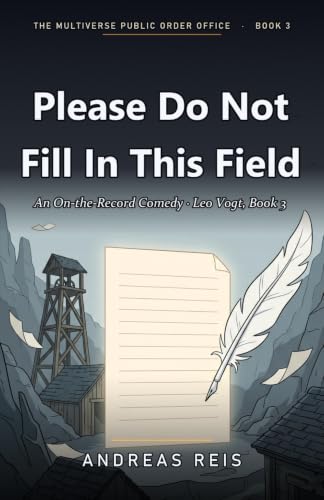
An On-the-Record Comedy · Leo Vogt, Book 3
English Band 3 der Reihe »The Multiverse Public Order Office« von Andreas Reis.
Worum es geht
A report comes in the like of which Leo Vogt has never read: 'Person in the vicinity noticeably changed. Suddenly too good.' No crime. No threat. Just people who turn flawless overnight — complete, error-free, happy — and in the process stop being themselves.
In a strange, cramped hand, a blank field fills itself in. The trail leads not to the sea but up into a range of slate mountains, to a small town where an authority administers reality not by date but by stratum of rock — and where one layer of stone lies too clean to be real.
So Leo, his chaos-gifted aunt Elara, the taciturn official Eberle, the bookseller Miriam — and a toaster currently practising restraint — gather up half the Public Order Office and drive uphill. This time no dragon waits, and no black hole, but something far more courteous: someone offering to write every life out, at last, without a single mistake.
The third case of The Multiverse Public Order Office — quiet, warm, more heart than action: a gloriously odd comedy about bureaucracy deep in the stone, three utterly different administrative cultures, an archive that once burned, and the bravest official act of all: to leave a field deliberately blank.
Auf einen Blick
- Reihe
- The Multiverse Public Order Office, Band 3
- Umfang
- 447 Seiten (Taschenbuch)
- Ausgaben
- Kindle, Paperback
- Sprache
- English
- Autor
- Andreas Reis
- Leseprobe
- Kapitel 1 vollständig, kostenlos
Hörprobe: Kapitel 1 zum Anhören
Das komplette erste Kapitel, ungekürzt vorgelesen (17:59 Minuten). Die Aufnahme nutzt eine synthetische Stimme.
Leseprobe: Kapitel 1
Das erste Kapitel in voller Länge (2792 Wörter) - kostenlos lesen, ohne Anmeldung.
%% PART: Part One — The Empty Field # Case Opened
By now there was a form for almost everything, and that was precisely why Leo Vogt grew suspicious first thing that morning.
Not because one was missing. Because none was.
He had been sitting at the workbench since half past six, the search list in front of him, the coffee and the clipboard, and had come to realise that over the past four weeks he had built up something like an administration that worked. There was a template for the recovery of a struck-out person. There was one for the provisional holding of someone not yet recoverable. There was, since Eberle had fallen three days earlier into a state of quiet rapture, even a template for applying for a new template, and Leo had stopped finding that funny, which he logged as the most worrying symptom of the lot.
A hairline rift had opened at around quarter past six above the engine room of the old hall. Leo had closed it before the coffee had finished filtering — two sentences, a form, a tick. He hadn’t even stood up to do it.
That, he thought, was growth. Or the opposite. With him the difference was rarely visible at first glance.
“I wish to state for the record,” the fridge rumbled from the corner of the workshop, “that the household’s range has risen noticeably since the north was connected, and that I feel confirmed in my significance.”
“Consulting hours are at five o’clock,” said Leo, without looking up.
“It is not a complaint. It is a positive status assessment.”
“It still counts as a contribution from the floor.”
“I shall note that as a curtailment of my participation rights.”
“You do that. There’s a form for it.”
The fridge thought this over, which you could tell because its compressor dropped a tone lower and for a moment sounded like a civil servant who had just resolved to sit out an official channel.
***
On the workbench, between the jar of honey that Eberle still regarded with the vigilance of a man who expected an application at any moment, and a bowl of water for Karo and Nulli, stood the radio.
It was ugly, it hummed, and on its side it carried a strip of tape that read, in Elara’s hand: **RADIO. DO NOT ADJUST.** Out of it came, quiet and coast-calm and with the delay of six hundred kilometres and two bureaucratic cultures, the voice of a woman who had not practised speaking for a long time and was just starting again.
“It’s low tide here,” said Almut. “The Register’s open. Nothing new overnight. The seagull’s challenged the tick again, but she does that every morning; by now it’s more devotion than objection.”
“Understood,” said Leo. “Quiet here too. A rift above the engine room, closed. Nothing else.”
A pause, in which you could hear the wind that was broader up there and took nothing personally.
“You say ‘nothing else’ as though it bothered you,” said Almut.
“It doesn’t bother me.”
“It bothers you,” said Almut, and it was not a question but the calm observation of a woman who had sat at a desk for years collecting names and therefore knew what silence sounded like when somebody was waiting for something. “I know the feeling. For our sort, quiet feels like a bill that hasn’t come yet.”
Leo said nothing, which was answer enough.
Out of the radio came a curt sound that Leo had learned by now to read as Ubben, followed by a single word that, in Ubben, constituted a complete situation report.
“Moin.”
“Moin,” Leo said back, and it still felt like a word in a language he was only halfway to mastering.
***
The yard between the workshop and the anchor house woke in the order it had assigned itself.
First the doves. They gathered shortly after six on the roof for the morning sitting, at which the self-appointed chair of the temporal administrative unit — the one with the paper tie — tabled an agenda item that no one understood and against which, therefore, no one raised an objection. Since the return from the north there was a seat in their order that pointedly stayed empty, and a second that had lately begun to do the same, which Eberle had logged under *expansionist tendencies, observation without alert level*.
Then Eberle, who arrived at the same minute every day, because for him punctuality was not a resolution but a state of matter. The first thing he checked was the three stacks beside his cup.
On top of the first, in squared official script: **Open Search List, Göppingen — not concluded.** Forty-one entries, more of them struck through than weeks ago, every stroke with a tick, every tick a person.
On the second, a little more hesitantly: **Branch Office North Sea — provisionally held.** Nine names, kept under a case-class that Eberle had invented himself on the coast and bore with the quiet satisfaction of a man who had, once in his life, not applied a regulation but made one.
There was no third stack. Leo noticed that every morning Eberle glanced briefly at the empty place beside the second, where a third might lie, and that he couldn’t tell whether that reassured Eberle or unsettled him.
Then Miriam, who never arrived but was simply, at some point, there, a book under her arm and a look that was half in the world and half inside a sentence. On the wall beside the board she had hung a map on which two points were joined by a thin red thread — a thread a little brighter than ordinary yarn, because it came from Hanna’s scarf and had once been a person, before it learned to hold a distance.
And finally Elara, who did not wake but surfaced from sleep like a device someone had left running by mistake, with solder marks on her sleeve and the firm conviction that she had only briefly closed her eyes.
“Morning, project lead,” she said, dropping onto the stool beside him. “You’re doing your face.”
“I’m not doing a face.”
“You’re doing the face you do when nothing has exploded for four weeks and you take that for a threat.” She took a roll someone had fetched rather than materialised, and considered it for a moment, as though it owed her an explanation. “I share the worry, by the way. Quiet is the state of matter in which machines most like to break.”
The toaster, standing on its little legs at the edge of the table, showed a single line on its display, with the restrained dignity of a device working on itself:
**I’M PRACTISING RESTRAINT.**
“Good lad,” said Leo.
The toaster showed nothing further, which in its case was the highest attainable degree of self-control.
***
It happened at twenty to nine, and it happened quietly, the way most things that genuinely meant something did.
Leo was filling in a form. It was the routine form for the closed rift of that morning, a yellow sheet with numbered fields, every one of which Eberle maintained was legally necessary, and at least three of which Leo suspected existed only so that the sheet would feel complete. He entered the case-file number, the time, the type of damage. He came to field nine, *Remarks*, which he left blank as always, because a closed rift deserved no remarks, and moved on to field ten.
Then he looked back at field nine.
It was no longer blank.
In the narrow white rectangle there now stood a line he had not written, in a hand that was not his — close, slanted, even, with the quiet confidence of someone who had not crossed anything out in a very long time.
*There would be room here for a better version.*
Leo sat very still.
He was a man who feared empty fields more than most people fear full ones, because an empty field demanded a decision. But this was the opposite of empty. This was a field someone had filled in for him, kindly, unbidden, without asking, and Leo found that this frightened him considerably more.
The silver scar in his right palm began to pull. Not alarmed. More like an old weather glass that senses something turning.
“Eberle,” he said, and his voice was steadier than his pulse. “Come here and tell me I wrote this.”
Eberle came, looked at the sheet, and went still in a way Leo had seen in him only twice in four weeks. He lifted the yellow sheet with both hands, held it to the light, turned it over, examined the back, where there was nothing, and set it down again, very carefully, the way you set down something you’re not sure is asleep.
“That is not your handwriting,” he said.
“I know.”
“It is not mine either.”
“That would have been the worse news.”
“It is no one’s,” said Eberle, and then, more quietly, because he was a man to whom the next word plainly came hard: “It is a foreign entry in an official form. That is —” He cast about for the category the horror belonged in. “— forgery of a document. At the very least.”
“I don’t think it cares what it is at the very least,” said Miriam.
She had stepped up beside them, soundlessly, the book still under her arm, and was looking at the line. She had a way of pausing briefly before important sentences, as though she were reading them to herself first, before she gave them away.
“We know this handwriting,” she said.
And that was true. Leo had seen it once before, four weeks ago, at the other end of the country, read out in the voice of a radio by a woman sitting by the water. *An empty field is an invitation.* Back then it had been a line on a desk, beside a broken quill. Now it was a line in a field that Leo himself had left blank a minute earlier, because he hadn’t wanted to fill it in.
Someone had decided that this was not permissible.
***
They gathered at the workbench, because everything that mattered in this family gathered at the workbench.
Elara drew the golden glasses from her apron — the same ones that had once belonged to a consolidated, flawless version of herself, and with which one now tracked down other people’s beautiful lies, because one had survived one’s own. She did not put them on. She only held them over the yellow sheet, at a distance, the way you hold a hand over a hotplate when you want to know whether it’s still hot.
The glasses glowed. Matt, golden, reluctant.
“Oh, marvellous,” said Elara.
“What does it mean?” asked Leo.
“It means this line wasn’t only written by someone.” She let the glasses sink. “It means it is *written*. In the technical sense. The way a false anchor is a beautiful lie, this is — a correction. Something that offers to replace something else.” She looked at the word *better*. “The glasses glow at beautiful lies. They glow here too. I don’t like that, because it means what began on the coast hasn’t stayed on the coast.”
“It’s here,” said Eberle.
“It’s *nearer*,” said Elara. “Which is something else, and worse.”
Above them, at the edge of the sky, lay the thing Leo had got into the habit of not looking at.
Over Göppingen the violet scar, thin, an old rift in which decisions were stored like ink under skin, with a small dark dot that was the most peace this town had to offer. Far to the north, barely visible by day, the green one, with a symbol that had opened four weeks ago like a mouth before a sentence.
And between them, at the edge of both, where the sky had by rights nothing to report, a third shimmer.
It was bright. Almost colourless. Neither violet nor green, but like the place on a sheet of paper where someone has wiped something away and is about to write something new. Eberle had named it the last time, and the name had stuck, because it was the most precise anyone had been able to find.
A Blank.
The space on a form not yet filled in.
Leo had spent four weeks hoping it would stay empty. He understood now that this had been a naive hope, because an empty field — the line on his yellow sheet had just informed him — was, for some, not peace but an outstanding account.
***
The clipboard beeped.
It beeped rarely, because Leo had set it to beep only when it was serious, and serious had been a rarity these past four weeks. Now it beeped twice, short, almost apologetic, and on the display stood an address and a sentence the device had automatically distilled from the incoming reports, and which Leo had to read twice before he understood it.
**CITIZEN REPORT: PERSON IN THE VICINITY NOTABLY CHANGED. DESCRIPTION: ‘SUDDENLY TOO GOOD’.**
“That,” said Leo slowly, “is not a damage report I’m familiar with.”
“What does it say?” asked Elara.
“Someone’s reporting that a person near them has — become too good.” Leo looked up. “Not ill. Not struck out. Not vanished. Too good.”
It went quiet at the table.
“That,” said Miriam, “is the most unsettling complaint I have ever heard.”
“I don’t find it unsettling,” said the fridge from its corner. “I find it understandable. If somebody near me suddenly functioned too well, I would report it too. On principle.”
“Nobody asked you,” said Leo.
“Consulting hours are at five o’clock,” said the fridge, with the unmistakable satisfaction of a device that had turned a regulation against its author, and Leo let it stand, because he had learned you didn’t have to fight every battle.
Eberle had already drawn a blank sheet towards him and taken a pen in hand. He looked at Leo, and in his face there was not fear — Eberle was not afraid of change; Eberle was afraid of jurisdiction — but a question he had learned, in four weeks of Network, to ask rather than adjourn.
“Do we go?” he asked.
Leo looked at the yellow sheet with the foreign line. At the glasses, glowing reluctantly gold. At the map with the two points and the red thread. At the third, bright shimmer at the edge of the sky, which neither threatened nor promised but was simply open, like a field that wanted filling in and did not yet know by whom.
Four weeks ago someone had written him a letter, and they had let it lie for three weeks. He had sworn that would not happen again.
“We go,” he said. “Today. We won’t go before breakfast goes cold — but today.” He took the pen and drew the blank sheet across from Eberle to himself. “And this time we don’t wait until someone else decides who we are.”
He wrote in the top field, where a case-file number belonged, more carefully than necessary.
Then he handed Eberle the stamp.
Eberle raised it, with the solemnity of a man declaring a quiet epoch over, and brought it down not on an adjournment but on the sheet, top left.
**CASE OPENED. RESPONSIBLE: THE NETWORK.**
Out of the radio, six hundred kilometres away, came the tiny, dry sound of a far too small pencil making a tick somewhere at the other end of the country.
“That’ll do,” said Ubben.
And then, brighter, younger, already half at a run, because she had evidently been standing nearby and listening in, Fenna’s voice:
“Shall I log it in the Register? Under what water level?”
Leo looked at the foreign line in field nine. *There would be room here for a better version.* He thought about the fact that someone had written that, kindly, without asking, in a field he himself had meant to leave blank, and that somewhere not far from here a person had just become too good, and that the two were the same thing.
“Log it,” he said. “Under open.”
Over Göppingen lay the violet scar, quiet. To the north lay the green one, calm, with a symbol that was opening. And between them lay the bright Blank, waiting to be written on.
But this time, Leo thought, and set the clipboard down, he was not waiting alone. And this time they were not waiting.
That was, as it would turn out, exactly the right decision, and came too late all the same, but they did not know that yet, that morning, and perhaps that was for the best.
Weiterlesen: ganzes Buch bei Amazon
Weitere Bände dieser Reihe
Take a Number for the Apocalypse
A Swabian Bureaucratic Comedy · Leo Vogt, Book 1
Bei Amazon ansehenHäufige Fragen
Worum geht es in »Please Do Not Fill In This Field«?
A report comes in the like of which Leo Vogt has never read: 'Person in the vicinity noticeably changed. Suddenly too good.' No crime. No threat. Just people who turn flawless overnight — complete, error-free, happy — and in the process stop being themselves. In a strange, cramped hand, a blank field fills itself in. T
Von wem ist »Please Do Not Fill In This Field«?
»Please Do Not Fill In This Field« ist ein Buch von Andreas Reis.
Wo kann ich »Please Do Not Fill In This Field« kaufen?
Direkt bei Amazon — als Taschenbuch und als E-Book.
An welcher Stelle der Reihe steht »Please Do Not Fill In This Field«?
Es ist Band 3 der Reihe »The Multiverse Public Order Office«.
Gibt es eine Leseprobe zu »Please Do Not Fill In This Field«?
Ja. Das komplette erste Kapitel »Kapitel 1« steht hier kostenlos zum Lesen und als Hörprobe zum Anhören.
Links zu Amazon sind Affiliate-Links. Kaufst du darüber, erhalte ich eine kleine Provision — für dich bleibt der Preis gleich.