The Woman in the Room Above the Lake
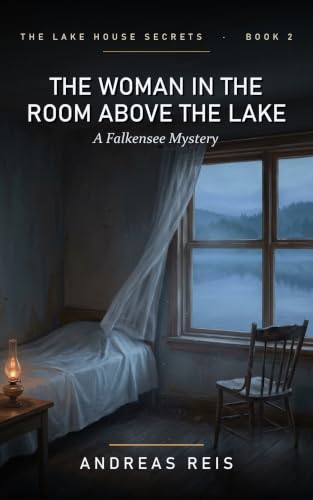
A cosy mystery of a locked room, a hidden woman and a village that chose to forget
English Band 2 der Reihe »The Lake House Secrets« von Andreas Reis.
Bei Amazon ansehen Weitere Ausgabe
Worum es geht
A room above the lake that was never officially let. A reservation card bearing a single letter: W. And a house that remembers, even when its people stay silent.
Mara Lenz did not sell the Seehaus-Café. She stayed — and now she climbs the old stairs to the locked room above the water.
Thirty years ago, someone lived there who was never meant to have existed. Old clothes, marks scratched into the window frame, the scent of lavender: the traces of a woman who was hiding — or was hidden.
The closer Mara comes to the truth about the room, the less the village wants her to find it.
The second Falkensee mystery in “The Lake House Secrets”.
Auf einen Blick
- Reihe
- The Lake House Secrets, Band 2
- Umfang
- 460 Seiten (Taschenbuch)
- Ausgaben
- Kindle, Paperback
- Sprache
- English
- Autor
- Andreas Reis
- Leseprobe
- Kapitel 1 vollständig, kostenlos
Hörprobe: Kapitel 1 zum Anhören
Das komplette erste Kapitel, ungekürzt vorgelesen (22:44 Minuten). Die Aufnahme nutzt eine synthetische Stimme.
Leseprobe: The Card with the Letter W
Das erste Kapitel in voller Länge (3303 Wörter) - kostenlos lesen, ohne Anmeldung.
Mara didn’t put the card next to Clara’s letter straight away.
She held it between her fingers a while longer, as though the thin paper might eventually explain on its own why it was so heavy. It was only a reservation card. Yellowed cardboard, the corners gone soft, the typewriter having pressed the letters slightly into the surface. An administrative scrap. A remnant from an old file. Something that, in the past, would have been filled out, filed away and forgotten.
Except nothing in the Seehaus café had yet agreed to be forgotten.
Clara’s letter lay on the table before her.
The envelope was open, the seal broken. The little house above the wavy lines no longer gleamed; it looked dull now, almost exhausted. *For Mara, when she comes home.*
By now she had read the sentence so many times that it no longer existed only on paper. It hung in the air of the café. Among the chairs. Under the ceiling. In the dust that had settled on the window ledges again during the night, as though the house had tried to cover everything that had been torn open yesterday with a thin layer of silence.
Mara had barely slept.
Not properly.
She had lain in the old guest room that hadn’t been one before and no longer wanted to be one now. The mattress smelled of detergent, wood and a trace of damp that could never quite be driven out of old houses. Outside, the lake had lain against the darkness, invisible but not silent. Every now and then water had stirred against the stones. Every now and then a beam had creaked. Every now and then Mara had believed she heard a floorboard in the café below.
Then she had held her breath.
But no one had come.
Or no one who still needed to walk.
Now she sat at the table by the window, the coffee before her untouched. Frau Baumann had hung a small bag of bread rolls on the door early that morning, without ringing the bell. Next to the bag there had been a note: *You don’t have to thank me. But at least eat one of them.*
Mara had read the note, folded it and placed it beside the cup. She had eaten nothing.
The coffee was now cold.
She looked at the reservation card.
The room above the lake.
17 July 1996.
Name: W.
The letter stood there alone, as though someone had begun writing down a person and then lost courage. No full stop after it. No addition. No first name, no surname, no town. Only W., in a straight, mechanical type that pretended it was innocent.
Mara finally laid the card beside Clara’s letter.
Paper beside paper.
Voice beside trace.
For a moment it looked tidy. Almost harmless. A letter, a card, a cup of coffee, the dull light above the lake. If a stranger had walked in, they might have thought Mara was arranging a little exhibition. A few old finds from the café, a bit of history, a sentimental return.
But nothing about this was little.
And nothing about it was history enough to be over.
Mara ran her thumb along the edge of the card. The cardboard was rougher than the sheet of the letter. Clara’s paper had, despite the years, retained a certain softness. The card had remained matter-of-fact. It had not suffered. It had merely waited.
That irritated Mara more than it should.
She stood, went to the counter and searched the drawer for the old bunch of keys Jonas had put there yesterday. There were too many keys on it. Little brass keys, coarse cellar keys, three with red tags, two without any markings. One still bore Elise’s handwriting. A narrow, slightly slanted hand that Mara recognised at once, although she had never wanted to love it.
*Upstairs.*
There was nothing else on the tag.
Mara didn’t take the bunch of keys out. She only laid her hand on it and let it rest there.
*Upstairs.*
The word was enough to lift her gaze to the ceiling.
Above her lay the room. Not directly above the café, perhaps slightly offset, depending on which building plans were correct and which one was permitted to believe. The room above the lake. The past weeks had led her through walls, letters, cellars, stairs and Hedda’s drawers. She had believed that Clara’s letter meant something had come to an end.
Instead, Clara had showed her a door.
Not just any door.
The door upstairs.
Mara took the bunch of keys, but she didn’t go to the stairs at once.
She hated that about herself. That she now knew how she moved when fear was steering her. First become matter-of-fact. First put things in order. First put one more cup away, smooth one more piece of paper, push back one more chair. First pretend that control was the same as courage.
She put the cup in the sink.
The coffee left a dark ring.
Elise had never let such rings stand. Mara saw her before her, moving across the tables with a damp cloth, brisk, precise, without much force. Her mother had kept many things clean. Tables. Cups. Windows. The counter. Her voice.
Not the truth.
Mara turned on the tap, let the water run briefly over the rim of the cup and then set the cup aside unwashed anyway. Not today.
When she turned round, Jonas was standing in the doorway.
He hadn’t knocked. Or she hadn’t heard it.
He wore a dark jacket that was still damp at the shoulders. His hair lay flat against his forehead, as though the morning hadn’t quite let him in. He held a paper bag in one hand and a folding rule in the other. He looked at the table, then at the bunch of keys in Mara’s hand.
“You were already awake,” he said.
“I wasn’t really gone.”
Jonas nodded, as though he understood the distinction. Perhaps he did. Perhaps he hadn’t got very far himself that night.
He placed the bag on the counter. “Frau Baumann intercepted me. She thought you wouldn’t eat anything.”
“That’s not new information.”
“No.” He looked towards the table. “But apparently an important one.”
Mara almost smiled. It didn’t get far enough.
Jonas stepped closer, but stopped in front of the table as though he needed permission to look at the things on it. That was new. In the past he would simply have looked, out of concern perhaps, out of the old habit of checking things in the house before someone else got hurt by them. Now he waited.
Mara didn’t know whether she was grateful to him for that or whether it made her angry.
“You’re allowed to look at them,” she said.
He bent over the card, but didn’t touch it.
“The room above the lake,” he read quietly.
The café seemed to grow stiller as soon as someone spoke the words aloud.
Jonas drew his brows together. “Seventeenth of July.”
“1996.”
“And W.”
Mara laid the bunch of keys on the table. The metal clinked too loudly. “I thought if I looked at it loudly enough, it might turn into a name.”
“It won’t.”
“Thank you.”
“I only meant—”
“I know what you meant.”
He fell silent. He’d got better at that by now. Not completely, not always, but better than at the beginning. Mara looked at his hands. A fine splinter of wood was stuck to one finger, which he evidently hadn’t noticed. His nails were cleaner than yesterday, but there was still dust in the grooves. The house clung to those who touched it.
“Do you want to go upstairs?” he asked.
Mara looked towards the stairs.
The old staircase led up from the café into the private area. It had looked different yesterday. Or Mara had looked at it differently. Since she knew what had been hidden under one of its steps, no staircase was simply a staircase any more.
“Not straight away.”
“Good.”
“Good?”
Jonas raised his eyes. “Yes. Good. Not out of panic.”
Mara looked at him sharply.
He didn’t retreat, but his voice grew more careful. “You said that yesterday. Or not exactly like that. But it sounded like it.”
She didn’t remember. Yesterday had been a series of sentences that no longer all belonged to her. Hedda’s voice. Brandt’s collapse. Clara’s letter. Jonas, who had stood beside her, sometimes too close, sometimes not close enough. And Elise in everything, without ever being in the room.
Mara sat down again.
Jonas remained standing.
“Sit down,” she said.
He did, slowly, on the opposite chair. Not on Elise’s chair. Mara didn’t know why she noticed that. Or why it calmed her.
Clara’s letter and the card lay between them.
“What do you know about the room?” Mara asked.
Jonas didn’t look at her straight away. He looked at the card, then at the window, then back at his hands.
“Not enough.”
“That’s the sentence everyone around here says just before enough arrives.”
He pulled the splinter from his finger, regarded it briefly and set it on the edge of a saucer. “It used to be a guest room. Officially, at least.”
“Officially.”
“Elise used it as a store room later. That’s what she said, anyway.”
“To you?”
“To my father. To me, only indirectly.”
Mara felt something close inside her at the word *father*. Not at Jonas’s father alone. At fathers in general. At men who turned up in sentences but not in answers.
“And you’ve been inside it?”
“Once. Years ago. Very briefly.”
“Why?”
“A water stain on the ceiling in the hallway. Elise thought it was coming from there. It wasn’t.”
“And?”
“It was full of things.”
“What kind of things?”
Jonas drew a breath. “Cardboard boxes. Old chairs. A bed frame, perhaps. I don’t remember exactly.”
“You remember if a floorboard is a millimetre out of true.”
“Yes.”
“But not a room?”
He looked at her now. “I remember that I wasn’t inside it for long.”
Mara was silent.
Outside, a wind moved across the lake. The water changed colour, from grey-blue to a dull silver, as though someone had spread light over it and then at once taken it back. The table reflected in the pane: Clara’s letter, the card, Jonas’s hands, Mara’s unmoving gaze.
“Did Elise send you out?” she asked.
“No.”
“Who, then?”
Jonas was silent. Too quickly.
That was answer enough.
Mara leant back. The chair creaked under her, an old, hoarse sound.
“Your father.”
“He was downstairs.”
“That’s not an answer.”
“No.”
She waited.
Jonas looked towards the stairs. “He said Elise didn’t want anyone walking about upstairs. I was sixteen or seventeen. It wasn’t my house. Not my story.”
“But it was your silence.”
The sentence came out harder than she had intended.
Jonas accepted it. Not well, not easily, but without resistance. That was the worst of it. If he had defended himself, Mara could have grown angrier. As it was, she was left only with the truth of the sentence, and that was heavy enough.
“Yes,” he said.
Mara wanted to reply, but at the same moment a heating pipe ticked somewhere above them. A single sound. Then another. No scratching, no footstep. Only the old house stretching itself into the morning.
Even so, both looked up.
The room above the lake was silent.
That was precisely why it was there.
Mara drew Clara’s letter closer to her. She didn’t have to read it again, not all of it. The last lines were inside her anyway.
*Dear Mara, if you’re reading this, your mother has finally stopped being silent.*
She didn’t run her finger over the words. She only touched the lower edge of the paper, where Clara’s hand might perhaps have hesitated briefly. Or where Mara now read a pause into it because she needed one.
“Clara wanted me to go upstairs,” she said.
“Perhaps she wanted you to know that things continue upstairs.”
“That’s the same thing.”
“Not quite.”
Mara looked at him.
Jonas shrugged slightly. “Going upstairs is an action. Knowing that things continue upstairs is a decision. You don’t have to do both in the same moment.”
She hated that he was right.
She hated even more that she wanted to hear it.
“Since when do you say clever things?”
“Since I say fewer safe things.”
This time the smile came closer. It stayed small, but it was there. The next moment it was gone again.
Mara took the reservation card and stood it upright on the table, as though she could defend herself better against it this way. The light from the window didn’t pass through the thin cardboard, but it showed the typewriter indentations more clearly.
The room above the lake.
17 July 1996.
W.
“Who books a room with only a letter?” she asked.
“Someone who doesn’t want to be found.”
“Or someone others don’t want to let be found.”
Jonas nodded.
Mara turned the card a little between her fingers. The edge wasn’t straight. A tiny piece was missing from the right side, as though it had been torn from a stack. No murder weapon, no great piece of evidence. Only damaged cardboard. But in this house, the little things had learnt to be worse than the big ones.
“Elise kept the card,” Mara said.
“Yes.”
“Why?”
“Perhaps because she couldn’t destroy everything.”
“Or because she wanted me to find it.”
Jonas said nothing.
Mara looked at him. “Do you believe that?”
“I don’t know.”
“That’s honest.”
“It’s not helpful.”
“It is.” She set the card down again. “It’s more helpful than protection.”
The word remained lying between them.
Protection.
In this house it had meant too many things. Love. Fear. Cowardice. Control. Letters in drawers. Doors that weren’t opened. Men who didn’t act. Women who vanished without being entirely gone. Children who were told afterwards that they hadn’t missed anything.
Mara stood up.
This time she took the bunch of keys with her.
Jonas moved as well, but stopped before he was fully standing. “Shall I come with you?”
Mara looked towards the stairs.
An answer didn’t come straight away. In the past she would have gone alone, to give no one the chance to stop her. Yesterday, perhaps even then. Now she sensed that going alone wasn’t always strength. Sometimes it was only an older form of flight.
“As far as the door,” she said.
Jonas nodded.
Nothing more.
They walked through the café. The chairs still weren’t standing quite right. One lay on its side, since yesterday, when she had knocked against it in passing and not picked it up. Mara didn’t right it now. The house was allowed to see that something had happened.
At the foot of the stairs she stopped.
The first step looked like all the others. Only Mara knew that wasn’t true. Clara’s seal had waited under it. Under it, a letter had lain that was no longer only the past. She set her foot on the step and felt the wood give slightly. Not weak. Only old.
Jonas stayed one step behind her.
The stairwell smelled cooler than the café. Of lime, old varnish and the dust that gathered in corners no one saw regularly. Light fell on the wall through a narrow window. It was weak light, but it was enough to make cracks in the paint visible.
Halfway up, Mara stopped.
The hallway began above.
She had remembered it as bigger when she was a child. Longer. Darker. Perhaps everything one was afraid of had taken up more room in the past. Today it was only a narrow corridor with three doors, an old runner and a chest of drawers on which an empty vase stood.
But the air was different.
Not colder.
More waiting.
The door at the end of the hallway was closed.
Mara knew it before Jonas said anything.
“That’s the one?” she asked.
“Yes.”
The room above the lake.
The door was made of dark wood, narrower than the others, with a brass nameplate that had been removed at some point. One could still see the lighter patches where it had sat. Two small screw holes. A rectangular shadow. As though someone had removed not only a name, but the fact that one had ever been there.
Mara stepped closer.
The wood smelled different from downstairs. Drier. No sound lay behind it.
She raised the bunch of keys. The keys clinked softly against each other. Jonas kept his distance. He did nothing that looked like pressure.
Mara searched for the key with Elise’s tag.
*Upstairs.*
Her fingers were dry. She noticed it because the paper of the reservation card that she was holding in her other hand suddenly seemed to cling to her skin. She had brought it with her without realising.
“Mara,” Jonas said softly.
“What?”
“You don’t have to do it today.”
She looked at the door.
Then at the card.
“Yes, I do,” she said. “Perhaps not go inside. But get this far at least.”
She put the key in the lock.
It didn’t fit.
Not even a little.
Mara tried again, more slowly, although she had known instantly the bit wouldn’t engage. Metal struck against metal. No turning. No yielding.
Jonas did step closer now. “May I?”
She gave him the key without looking at him.
He checked it, then the lock. Not for long. His hand knew faster what was wrong than his mouth wanted to say it.
“It doesn’t belong to this,” he said.
“Elise labelled it.”
“I know.”
“So?”
Jonas knelt down in front of the door and examined the lock. He ran his thumb across the escutcheon. “The lock’s been changed.”
Mara heard the sentence, but it didn’t reach her straight away. It hung in the hallway, between the old vase and the pale patch where the nameplate had been missing.
“When?”
“Not recently. But later than the door.”
“After 1996?”
Jonas was silent a moment too long.
“Probably.”
Mara looked at the card. The letter W was suddenly no longer on paper but on the door. On the removed nameplate. On the wrong key. On the lock that someone had exchanged so that a labelled key was no longer enough.
“Someone didn’t want Elise still to be able to get in,” she said.
“Or didn’t want anyone with Elise’s things to be able to.”
She turned her head towards him.
Jonas stood up slowly. “That’s not the same.”
No, Mara thought.
Nothing here was the same.
She pushed the reservation card into her coat pocket, but the cardboard resisted at the edge. She pulled it out again so as not to bend it. In doing so, she inadvertently turned it over.
For the first time she saw the back.
There was something written there.
Not with a typewriter. Not in Elise’s handwriting. Thin, almost pressed into the paper, as though someone had written with too little light and too much haste.
7A.
Mara blinked.
“Jonas.”
He looked first at her face, then at the card.
“What is it?”
She held the back out to him.
He didn’t take it. He only read.
His brow furrowed.
“That’s not a room number,” Mara said.
Jonas didn’t answer.
She looked at the door, then along the hallway, to the other doors, to the chest of drawers, to the empty vase, to the shadows on the wall.
“Is it?”
Jonas was still looking at the back of the card.
When he spoke, his voice was quieter than before.
“Not officially.”
Mara felt the hallway change around her. Not visibly. Not audibly. But something had opened, without the door having yielded.
There stood a room number on the card.
A number that had never officially existed in the Seehaus.
Weiterlesen: ganzes Buch bei Amazon
Weitere Bände dieser Reihe
The Café of Unsent Letters
A cosy mystery of an old lakeside café, unsent letters and a family secret
Bei Amazon ansehenThe Photograph No One Took
A cosy mystery of old negatives, a missing figure and a summer that left its mark
Bei Amazon ansehenThe Voice from the Old Radio
A cosy mystery of an old tape, a hidden recording and a voice that refused to stay silent
Bei Amazon ansehenHäufige Fragen
Worum geht es in »The Woman in the Room Above the Lake«?
A room above the lake that was never officially let. A reservation card bearing a single letter: W. And a house that remembers, even when its people stay silent. Mara Lenz did not sell the Seehaus-Café. She stayed — and now she climbs the old stairs to the locked room above the water. Thirty years ago, someone lived th
Von wem ist »The Woman in the Room Above the Lake«?
»The Woman in the Room Above the Lake« ist ein Buch von Andreas Reis.
Wo kann ich »The Woman in the Room Above the Lake« kaufen?
Direkt bei Amazon — als Taschenbuch und als E-Book.
An welcher Stelle der Reihe steht »The Woman in the Room Above the Lake«?
Es ist Band 2 der Reihe »The Lake House Secrets«.
Gibt es eine Leseprobe zu »The Woman in the Room Above the Lake«?
Ja. Das komplette erste Kapitel »The Card with the Letter W« steht hier kostenlos zum Lesen und als Hörprobe zum Anhören.
Links zu Amazon sind Affiliate-Links. Kaufst du darüber, erhalte ich eine kleine Provision — für dich bleibt der Preis gleich.